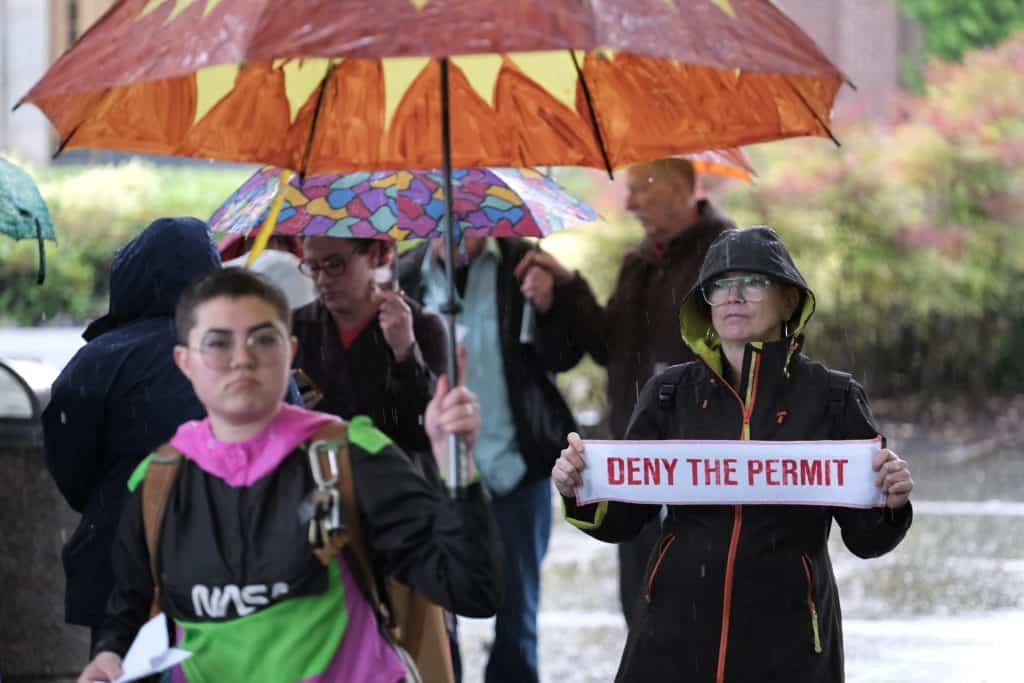
Photo Credit: Alex Milan Tracy
Originally published in Columbia Riverkeeper “Currents” Issue 2, 2025
We all have different expertise, and we all have a stake and a voice in protecting the Columbia.
By Miles Johnson, Legal Director
The threats to the Columbia River and our communities are serious. But so are the opportunities to defend what we love, and even strengthen state and local protections for clean water and the climate. Here are a few of the strategies Columbia Riverkeeper will use in 2026.
Tell the Truth
In the face of lies and deception, we will operate with honesty and integrity. Count on Columbia Riverkeeper to bring you accurate, relevant information about how to enjoy—and protect—the Columbia River. Our staff have the legal and policy expertise to comb through thousands of pages of technical documents and find the right data to sway a decision-maker or judge. Our scientists monitor water quality at swimming beaches and share that information via SwimGuide so that you can use the river safely. When government agencies withhold public documents, our attorneys use records requests and litigation to ensure transparency. We work hard to present information to you in ways that are both accurate and understandable. We all have different expertise, and we all have a stake and a voice in protecting the Columbia.
Beyond our staff, we hire scientists and consultants from a variety of fields to bring critical information to the public and policy makers. In 2025, we helped publish detailed factual reports on how data centers will affect energy and water use in the Northwest, how the Lower Snake River dams waste massive amounts of water through evaporation, and how NEXT Energy’s
proposed diesel refinery won’t live up to its “renewable” hype. Next year, tune in for groundbreaking research on how Snake River dam removal would increase salmon and orca populations, revelations about fracked gas pipelines proposed near the Columbia, and real-time tracking of progress toward replacing electricity from the Snake River dams. Knowledge is still power.
Act Locally
Columbia Riverkeeper has always focused on state and local solutions, and working in solidarity with Tribal Nations. For good reason: state and local decision-makers are far more accessible and accountable to river communities than any president in the “other” Washington.
State and local officials are also more willing to use their legal authority to protect clean water, climate, and communities when the president is attacking them. You might call this political posturing; we call it opportunity.
Despite many challenges, we have real opportunities to work with Tribes and regional policy makers to increase protections for clean water and healthy communities. We don’t intend to waste them.
Examples of How We’ll Push Local and State Policymakers to Protect the Columbia River in 2026:
- Work with allies, Tribes, and members of the public to make sure that Oregon legislators keep saying “no” to bills that
would allow nuclear development in Oregon. - Support implementation of the City of Vancouver’s Climate Action Framework and Clark County’s Climate Project.
- Encourage the Washington Dept. of Ecology to use its full authority to find solutions to heat pollution from the Lower
Snake River dams. - Continue to elevate and implement the Columbia Basin Restoration Initiative, the historic agreement among the
states of Oregon and Washington and the Tribal Nations of Nez Perce, Yakama, Umatilla, and Warm Springs.
Defend Environmental Laws
Columbia Riverkeeper wields federal environmental laws—like the Clean Water Act—to protect water quality, recover salmon, and defend river communities. The Trump administration is weakening and ignoring those laws. Alongside states, Tribes, and other organizations across the Northwest and the nation, we are doing our part to defend bedrock environmental rules and hold the federal government and polluters accountable.
We’ll go to court to defend what matters. The Trump administration is trying to rewrite regulations to harm the climate and the Columbia, but many of the new rules and orders are illegal. In 2026, we will challenge a rule that removes long-standing protections for the habitat of endangered fish and wildlife. We also anticipate, and will likely oppose in court, federal attacks on states’ authority to protect water quality and efforts to weaken Washington’s clean water laws. We’re also prepared in the event the U.S. Dept. of Energy follows through on its plan to
Build Power
When we value one another and work together for a healthy Columbia and safe communities, our movement gets stronger.
Seemingly insurmountable challenges—like stopping Tesoro’s oil-by-rail terminal—have given birth to powerful and effective new networks of friends and neighbors who understand how to protect what matters. We will face new and unprecedented threats to public health and the environment in 2026. In the process of defending the Columbia, we will forge strong, lasting, reciprocal and powerful relationships among colleagues, partners, policy-makers, community members, and Tribal governments.