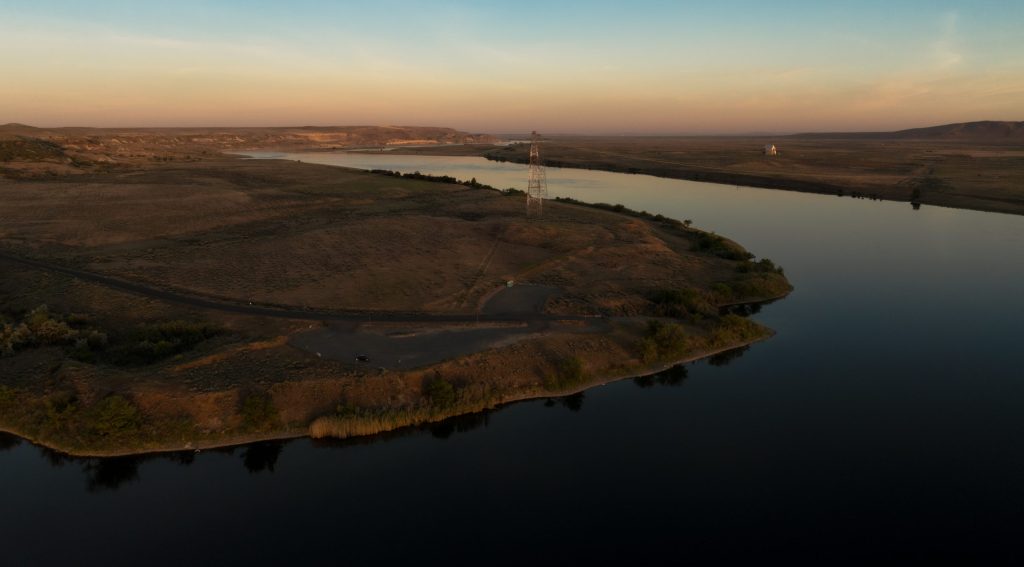
Hanford Nuclear Site: 2025 in Review
Columbia Riverkeeper’s very condensed timeline of the Hanford Nuclear Site in 2025
By: Simone Anter, Senior Attorney & Hanford Program Director
This last year proved to be tumultuous and pivotal at the Hanford Nuclear Site, with many actions that will reverberate through time. Historic milestones were reached and greedy eyes turned towards Hanford with a lust for new fission development and profit, risking the clean water and healthy environment that decades of activism have fought for.
Events brought the next generation to Hanford, and Columbia Riverkeeper worked hard to keep the public informed about what was going on at the site. As we pivot to new challenges of 2026, let’s reflect on this last year: check out our condensed timeline of the Hanford Nuclear Site in 2025.
January – Columbia Riverkeeper sent a letter to the Washington Department of Ecology (Ecology) Director Sixkiller, urging Ecology to support reanalysis of areas of Hanford in light of the U.S. Environmental Protection Agency’s (EPA) updated hexavalent chromium standards. The momentum for addressing chromium has been building for years, and your voice has helped us to ensure that both EPA and Ecology hold the U.S. Department of Energy (Energy) accountable for this toxic pollution throughout Hanford. Read: In this letter we asked Ecology to clarify next steps in implementation of EPA’s new health standard for hexavalent chromium at the Hanford Nuclear Site. Going back even further in time, you can check out EPA’s response to our letter in 2023 here. Sustained appreciation of the importance of chromium cleanup helps government agencies sustain cleanup efforts.
February – Advocacy Director Dan Serres talked to Columbia Insight about the Tri-Party Agencies’ (Ecology, EPA, and Energy) adoption of the Holistic Settlement Agreement. The center of the agreement? Hanford’s tank waste — a byproduct of a decades-long military operation at Hanford, which produced two-thirds of the nation’s plutonium for nuclear weapons. Read: “Major agreement reached over nuclear waste.”
March – Policy Director Kelly Campbell and Senior Attorney Simone Anter spoke on a panel, Nukes Across The Columbia?– Prepping for SMNRs in Washington to Power Oregon’s Data Centers, at the Public Interest Environmental Law Conference in Eugene, OR.
April – Columbia Riverkeeper submitted our Hanford cleanup priorities to Energy. Our top priority? Don’t lose sight of the river corridor. Read our comments.
May – Hanford Challenge and Columbia Riverkeeper traveled to Spokane, Washington to speak to community members and hear their concerns about the U.S. Department of Energy’s management of Hanford’s radioactive tank waste, and potential shipment of tank waste through communities throughout Washington and Oregon, including Spokane. In May, we submitted those comments to Energy. Read them here. Meanwhile, at the Hanford shoreline, dozens of students from White Swan and Sunnyside High Schools gathered on boats and buses to learn and share ideas about our hopes for clean water, clean air, and the future of the Hanford Reach National Monument. Hear from students and Elders.
June – Columbia Riverkeeper filed a lawsuit against Energy for violating the Freedom of Information Act (FOIA) by failing to produce documents related to Energy’s “Cleanup to Clean Energy Initiative” at Hanford. The Initiative proposes to lease 19,000 acres at Hanford for clean energy development, including the potential for new nuclear energy infrastructure. Read our press release.
July – Columbia Riverkeeper met with Ecology Director Sixkiller to discuss our January letter and deliver over 800 signatures from our members who expressed support for Ecology’s continued push for reanalysis of areas of Hanford in light of EPA’s new hexavalent chromium standards.
August – Columbia Riverkeeper and over 800 of our members and supporters submitted comments regarding the cleanup plan for Hanford’s 324 Building, located 1,000 feet from the Columbia River. Together, we urged Energy to handle the soils under the building as high-level waste, which would disallow shallow disposal at Hanford’s onsite landfill. You can read our detailed comments and petition here. Meanwhile, near Hanford, dozens of Yakama Nation Tribal members, elected leaders, and traditional food preparers welcomed a survivor of the bombing of Hiroshima and a group of young people studying the movement for peace and resistance to nuclear colonialism in the West, marking the 80th anniversary of the bombings of Hiroshima and Nagasaki.
September – Energy released its groundwater monitoring report for 2024. A startling result showed a reading of 51,400 micrograms per liter of uranium in October 2024 in perched groundwater near the B plant. Good news: Energy intends to extract and treat the polluted groundwater with a robust pump-and-treat system. Bad news: the level of uranium contamination is still astoundingly high: the drinking water standard for uranium is 30 micrograms per liter. Check out the report as well as Ecology’s comments on the report.
October – Energy announced that the Waste Treatment Plant is officially operational, turning low level tank waste into glass at the Low-Activity Waste Facility. Read Ecology’s press release.
November – Energy began moving the first highly radioactive cesium and strontium capsule out of the Waste Encapsulation and Storage Facility’s (WESF) aging water basins and into dry storage. A momentous achievement, but not without risk, as the Defense Nuclear Facilities Safety Board gave Energy an extension to further test the viability of the dry storage capsule’s seals and their ability to contain helium, which dissipates heat from the radioactive cesium and strontium inside the capsules. Read the DNFSB letter to Energy. In November, Dan Serres traveled to Nevada for the fall meeting of the Alliance for Nuclear Accountability, where people from all over the U.S. discussed the challenges with radioactive waste. Read about his journey here.
December – Columbia Riverkeeper was made aware of modeling done by PNNL in regards to the 324 Building soil contamination reaching groundwater. While the modeling showed that even if the 324 Building were removed, under normal precipitation rates, it would take 150 years for the radioactive contamination to reach groundwater. However the modeling failed to account for water intrusion caused by dust suppression or abnormal precipitation rates caused by climate change. The public continues to be left in the dark when it comes to the risks this building — and its potential demolition — poses to the Columbia, the groundwater, and air, making full participation in the public process nearly impossible.
So what’s next for 2026? Columbia Riverkeeper will continue to watchdog the cleanup and, with the help of our members and supporters, hold the U.S. government accountable to a thorough and just cleanup of the site. This year will not be the year that the cleanup is sidelined or recklessly fast-tracked.
Funded in part by a Public Participation Grant from the Washington State Department of Ecology.