Standing Up to Fallout in Nevada
By: Dan Serres, Advocacy Director

In November 2025, Columbia Riverkeeper sent me as an emissary to Las Vegas, Nevada to attend the fall meeting of the Alliance for Nuclear Accountability (ANA), which coincided with the International Uranium Film Festival. The ANA was established in 1987; “[f]ormed by organizations from communities in the shadows of nuclear weapons facilities, ANA includes more than 30 local, regional, and national organizations concerned about the consequences of U.S. nuclear weapons and waste policies.” Riverkeeper was honored to join ANA as a member organization in 2025 and connect with such an incredible group of advocates from across the nation.
Meeting some of these dedicated folks in-person was a unique kind of boost: it was reassuring to see so many people with open, caring hearts working with such precision in organizing, art, law, and science to attend to the harms of nuclear weapons, even when the U.S. government would not. And visiting the Nevada Test Site, a place where the U.S. government detonated over 900 nuclear weapons in Shoshone territory, was a harsh reminder that the harm of Hanford’s plutonium extended far beyond the Columbia River Basin.
In Nevada, I met dear allies of nuclear resistance. First among them to welcome me, Ian Zabarte of the Western Shoshone Nation, our host and a person of astounding energy, incredible knowledge, and talent for speaking and sharing, put a cup of coffee in my hand before I even knew I needed it (I needed it badly — it’s a long drive from Portland to Las Vegas!). His beautiful pug also welcomed me as I marveled at the kindness of the folks Ian introduced me to, who had never met me, but seemed to know Columbia Riverkeeper’s work thoroughly.
You can read more about Ian’s work and the work of the Native Community Action Council in this intense Al Jazeera piece, where Ian describes the fallout impact of nuclear testing in Western Shoshone lands:
Ian’s words:
When the fallout came down, it killed the delicate flora and fauna, creating these huge vulnerabilities across thousands of square miles of Shoshone territory. The pine trees we use for food and heating were exposed, the plants we use for food and medicine were exposed, the animals we use for food were exposed. We were exposed.
As a result, we have watched our people die. Some of the strongest defenders of our land, of our people, just gone.
But we have to protect our land and our people. Our identity is the land. Our identity is the pure pristine water coming out of the ground, flowing for millions, tens of millions, hundreds of millions of years. We see that pure water as a medicine. People need that pure water to heal.
-Ian Zabarte is Principal Man of the Western Bands of the Shoshone Nation of Indians.
Ian’s message, his warm welcome, and his call to action touched my heart deeply. Ian did everything during those four days: driving, cooking, cleaning, and helping to uplift the voices of the folks on the margin of the meeting by identifying his own experiences of watching his family fall ill, and pass away, carrying knowledge and beauty beyond words with them. He even sent me home with a healing sage balm, made by his family member, for my itchy wind-dried bald head. I left the first day with a renewed sense of urgency to halt the spread of contamination coming from Hanford into the Columbia River Basin and the landscapes connected to it, a threat to eons of clean water and the people who depend on it.
What I Learned
I learned more and more as the days continued, lessons about how to think about protecting the Columbia River while maintaining solidarity with geographically distant, but highly connected communities. Kevin Kamps, one of the longest-serving leaders of ANA, filled me in about the landscape of organizations I was to encounter, and the amazing individuals who held them together. He told me about challenges in Michigan where, like what occurred in Georgia with Plant Vogtle, the nuclear industry was preparing to saddle ratepayers for more costs with nuclear power. In Michigan, a “decommissioning” had veered suddenly into a “nuclear renaissance” — language that just glosses over the reality: poisonous substances leaching into water that people use.
I learned from Kimberly Scott, a leader from Georgia WAND, about the runaway costs of Plant Vogtle, with bills spiking for people in Georgia. Their report on this hefty cost helped us identify likely unseen, unexpected costs for Northwest ratepayers, should new nuclear reactors come to pass. Kim offered a perspective that comes from the experience of people not being able to pay bills for nuclear power. The story of Georgia WAND’s work to expose these problems, and the attendant pollution that lands disproportionately on already overburdened communities, causes us to recognize more clearly the patterns of injustice here in the Northwest, where Tribal communities and frontline communities in urban and rural areas bear so many of the costs of our power systems, and reap so few of the benefits.
In a stark cold morning, we visited the Peace Camp area across the highway from the Nevada Test Site, where we were welcomed by people from the Western Shoshone and Northern Paiute and Southern Paiute Tribes, a circle of peaceful people who deepened my view of this spectacular desert as astoundingly, bountifully, beautiful – not a wasteland at all, but filled with laughter, wildlife, and birds. Accounting for the wind chill, it was 35 degrees, but I tried to follow the example of the elders in our group who stood with dignified strength and power, including friends from Texas who watchdog the potential spread of nuclear waste there from Hanford and beyond, leaning on canes or one another, and listening to the words of the people who had called us there to make a statement about peace and justice.
Highlights at ANA
Later during the ANA gathering, these same wonderful leaders would lead us in a clockwise dance, rallying for life, peace, and justice under the gaudy lights of the Las Vegas Strip. I am so grateful to Star and her grandmother for these moments, Southern Paiute Tribal members, who called us together. Star led us while her grandmother sang, our feet moving in the rhythm they taught us. We were grateful to participate (so many different generations, too — elders, middle-agers like me, and younger folks moving together). The words Star and her grandmother shared with us — that we were calling forward a better world by standing up to nuclear testing and new fission reactors — kept me focused on the potential for peace to prevail over nuclear weapons and unsafe experiments at Hanford. As we moved, my thoughts traveled to Hanford’s White Bluffs.
The surprising part to me was that almost every single person who passed by us in the cool Las Vegas evening seemed to welcome the message and support it, honking, waving, or even stopping to talk. We wanted to make a statement about joyful, yet serious, resistance to harmful nuclear waste emanating from weapons and power stations, and we were met with a positive response. I’m grateful for the people who passed by us to cheer and encourage our statement that day.
Every day at the ANA, people shared thoughts and observations about how to push for justice for the myriad communities impacted by the horrible impacts of nuclear weapons production, use, and testing. I learned immensely from the patient discussion and facilitation — from Tanvi, Sophia, Amy, Scott, Leigh, and many others in the group — who focused our attention on how we could work together to accomplish difficult goals. They nudged us to do more, to object to new plutonium waste generation, and to confront racism underpinning nuclear colonialism. (You can read about the potential impact of creating new plutonium pits for new nuclear weapons in a recent article from Kimmy Igla, a leader with Peaceworks in Kansas City and Physicians for Social Responsibility-KC.) The connection to Hanford is tangible: if the U.S. makes more plutonium waste, it could end up glutting disposal sites while threatening to orphan more waste in shallow disposal in places like Hanford. Tanvi and Sophia helped us connect our thoughts, resolve inconsistencies or misunderstandings, and push forward towards thinking about how to make an impact in 2026.
What Connects Us
From Georgia to Idaho, the web of knowledge was strengthened by these shared experiences and stories, and I felt honored to listen in, to ask questions, and to understand what role we could play in making sure that our struggle lifted the others, as well.
Tackling fallout was one of the key themes of these discussions — how to bring the invisible impacts of nuclear recklessness into the light of accountability. One of the first group activities was learning from a brilliant and kind scientist named Michael, who taught us to build an alpha particle air radiation pollution monitor for future Hanford events such as wildfires. He offered science with a moral vector, a warm heart drawing on deep knowledge to build a healthy community, and I could see how deeply he felt concern for the people who lived in areas with increased fallout from nuclear weapons activities, like Hanford. It turns out, you can do some amazing science with an $80 blower and the right kind of simple carbon filter. I drove home with several copies of the specifications for the device, and we have plans to use these in the future to see what comes through the air during fire events at Hanford.
Every night, there were films showing people of Indigenous roots standing up to nuclear colonialism. Bomb after bomb, explosions compounding, the films pummeled my consciousness. I had to step away at times, feeling overwhelmed. But I was with friends who answered my questions and steadied my thoughts, and I could feel through their strength how we steeled ourselves in the knowledge that the hope of a less nuclearized world is what we train for every day.
Moving Stories
After one particularly powerful film, Giselle and Chris from Boulder, Colorado’s Rocky Mountain Peace and Justice Center offered information about how that community was still grappling with a cleanup that felt incomplete, and development encroaching on areas that had never been adequately remediated. This felt highly relevant to Hanford, where data centers, AI infrastructure, and other developments are planned on lands right at the edge of the Hanford Site. A group from Peaceworks in Kansas City helped me understand the industrial centers of nuclear weapons production and research, facilities which were linked to Hanford’s plutonium in ways I had not thought about. (To read a little more about the ANA, check out this lovely reflection on the meeting from Jane, Ann and their colleagues at Peaceworks).
On one morning, Kevin and Ian introduced me to the coordinators of the International Uranium Film Festival, Márcia and Norbert, who came from Brazil and Germany, respectively, and who instantly resonated with our challenges on the Columbia River with their own experiences of seeing the harms of mercury, radiation, and toxic metals in their vast and superabundant watersheds. I learned so much from the filmmakers they had brought together and the insights they shared about the deep-seated fear that gnaws away at the communities who live in fallout areas, with illnesses developing in cultures of secrecy surrounding uranium mining, plutonium weapons production, testing, and use. Most importantly, they confirmed my hope that there are indeed people all over the world with advanced ideas on how to tackle nuclear colonialism with art, courage, creative action, and science.
One of the most startling parts of the Film Festival was the film, “To Use a Mountain,” a long exploration of how the federal government evaluated alternatives for storing high-level nuclear waste. It just so happened that wonderful activists, Tom and Diana Gordon, from Washougal, WA, had just given to me a giant pile of National Environmental Policy Act (NEPA) review documents specific to the issues in the film. From Louisiana, to Oak Ridge, to Hanford, to Nevada, and beyond, I have thousands of pages of federal environmental analysis sitting in my office, the federal environmental record that paralleled the remarkable film. Speed-reading through some of the files given to me in October and November had given me more perspective on high-level waste, and a greater appreciation for the fact that salt domes exist underground in the southern part of the North American continent. The film opened my eyes in a different way to the experiences of people living in these areas: I was suddenly able to see on the screen the real people who had stood up and explained to the federal government why their watersheds were unsuitable for high-level nuclear waste. I am so grateful to these folks, whose knowledge is handed down to the next generation of geniuses, a process facilitated by ANA’s members.
The Value in a Road Trip
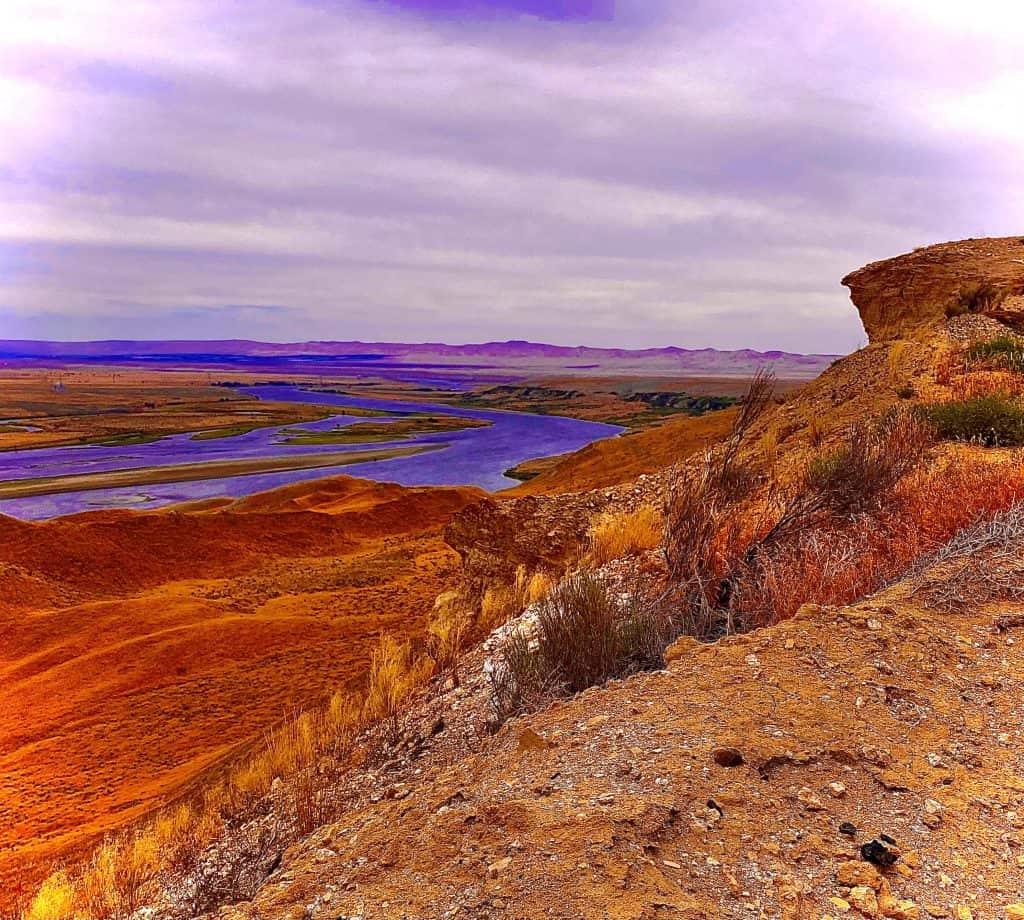
The experience was framed by my drives to and from Las Vegas, many hours of seeing through clouds, mists, and suddenly clear skies, the rhythm of basin and range, and mountains that spike up in unpredictable ridges and frame the places that have sustained the many Tribes who live there.
I saw how data center development was capturing land on the edges of towns, having sprung up massively since my last trip just a year prior along this route. I am grateful to my Columbia Riverkeeper colleagues like Lauren Goldberg and Kelly Campbell who watchdog the connections between nuclear energy and data centers, and I was able to offer as a resource to the ANA group their recent, excellent webinar on the topic.
On my long drive along Highway 95, I was joined by peaceful donkeys whose ankles were toughened on angular, sharp Nevada rocks. They came to visit me on a side road, a whole group of them, and stood unfrightened by me while I meandered and read the graffiti that spelled out the words, “Read more books!” in bright blue on the sun-bleached concrete building in the desert. That is graffiti that I can stand behind!
Further north, there were antelope — vague bolting figures in the distance. And I knew that the people of this place — the Western Shoshone in particular, through Ian and his miraculous whirlwind of information and thought — had offered me a message to carry back to the people near Hanford: we learn the history of the suffering caused by nuclear tests, and we bear witness to the courage of people who resist more testing and more fission, so that all of the nuclear-impacted communities could find increased justice.
When I managed to find myself back in the Clackamas watershed where I live, having seen lithium mining trucks, vast post-fire logging, and fallout along the way, I dove into the icy water near the confluence of the Clackamas and Collowash River, offering a prayer that there could be peace and firm resolve that Nevada would never be bombed again. Part of the desert felt locked in, after that swim, an inspiration to do more in 2026 than we ever have before to protect and restore Hanford. To Ian, Kevin, Tanvi, Scott, Sophia, Amy, Leigh, Tim, Ann, and all the rest of the team who shared so much heart and wisdom with me, I say thank you.
Back at the office, I find a mountain of NEPA documents, and I feel more connected to the people who act with courage and defend the places named in them.
Postscript –
- Upon returning to the Northwest, I learned that the Manhattan Project National Park, which includes the B Reactor at Hanford, had a problem unknown and unreported until this November.
- At the B Reactor, radioactive powder was spilling from an artifact, and the risk of beryllium exposure remained unsure as well. Yet untold thousands of people have passed through the B Reactor building exhibit since its opening years ago. This troubling note from the Defense Nuclear Facility Safety Board (DNFSB) underscored the lessons from visiting ANA in Nevada: we should be hesitant to trust Energy when it claims that radiation has been contained.
- At the B Reactor, radioactive powder was spilling from an artifact, and the risk of beryllium exposure remained unsure as well. Yet untold thousands of people have passed through the B Reactor building exhibit since its opening years ago. This troubling note from the Defense Nuclear Facility Safety Board (DNFSB) underscored the lessons from visiting ANA in Nevada: we should be hesitant to trust Energy when it claims that radiation has been contained.
- B Reactor: Contractor personnel are preparing for architectural and structural repairs to the B Reactor, which was decommissioned and decontaminated for public access as part of the Manhattan Project National Historical Park.
- B Reactor personnel were cataloguing, packaging, and storing artifacts in the facility’s basement prior to construction activities when they observed powder spilling from an artifact. Personnel immediately paused their activities, made notifications, and requested radiological control response. A radiological control technician performed surveys, which indicated alpha contamination in the powder. Because of the cautious and prompt response, no personnel were contaminated, and the powder was confined to the table on which the artifact rested. Resident inspectors observed the initial contractor meeting to discuss the event and the work planning to recover the area. Based on the information gathered, personnel noted that the artifact was likely surveyed as clean when it was first transferred to the Manhattan Project National Historical Park over a decade ago because the container had shielded its contents until it was upended. While it was kept in a non-posted room as part of a historical display, members of the public did not interact with the object and were never at risk from exposure. During the planning to re-enter B Reactor to sample and clean up the material, the resident inspector noted that there was a potential for beryllium contamination. As a result, workers discussed additional sampling and controls to be added to the work package. The resident inspector also discussed ways to improve the receipt inspection and survey of artifacts donated from other facilities and members of the public. CPCCo personnel intend to sample the powder, decontaminate the room, and dispose of the artifact as waste. The contractor will perform new radiological surveys of all other artifacts at the B Reactor to verify the safety of workers and members of the public.