
Originally published in Columbia Riverkeeper “Currents” Issue 1, 2026
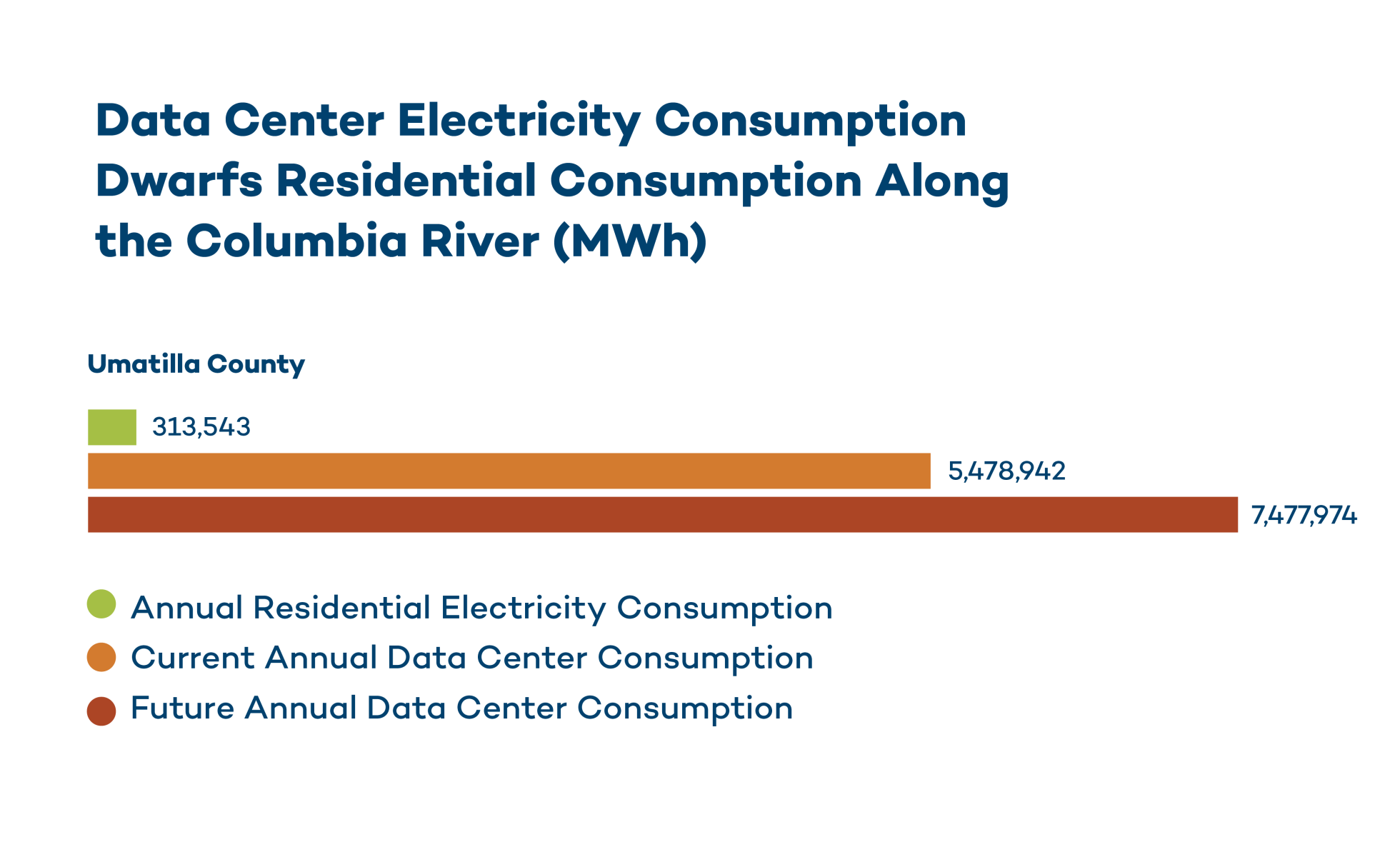
Data center power demand in Oregon and Washington could reach 35 million megawatt hours by 2029—the equivalent energy demand of four cities the size of Seattle.
By: Kelly Campbell, Policy Director
What’s At Stake
It’s hard to escape news about AI and data centers, and the enormous amount of energy and water Big Tech is demanding to build more facilities. Data center expansion is driving demand for fossil fuels, including new gas pipelines, power plants, and even small modular nuclear reactors. Unless we act soon, an unprecedented buildout of data centers in Oregon and Washington will derail some of the nation’s strongest clean energy laws, including state mandates to decommission gas- and coal-fired power plants and reach 100-percent renewable energy by 2040 and 2050, respectively. In fact, data center power demand in the two states could reach 35 million megawatt hours by 2029—the equivalent energy demand of four cities the size of Seattle.
With timely intervention, the Northwest could become a model for smart data center regulation that allows for a just transition from fossil fuels. In 2025, Columbia Riverkeeper launched a campaign for responsible regulation to address the impacts of data centers. In a recent report, “A Closer Look: Columbia River Data Centers,” we identified more than 100 data centers at various stages of development and operation concentrated in just 12 mostly rural counties along the Columbia River. Current regulations are not geared for the scale of the data center industry. Big Tech— Amazon, Microsoft, Google and Meta—are taking advantage of rural communities to build as fast as possible, often irresponsibly.
Opportunity for Impact
Oregon and Washington can create the playbook for states around the country to address largely unchecked data center expansion. Columbia Riverkeeper has been hard at work developing and implementing a multi-pronged campaign to engage various levels of government in both states to address the climate, water, and salmon-recovery impacts of data centers. We are actively working with community members, Tribal governments, and the Columbia River Inter-Tribal Fish Commission, which represents four Columbia River Treaty Tribes.
We understand that achieving a just energy future will require substantial changes to our region’s regulatory and physical infrastructure. This will include regulating how, if, and where data centers are sited and operated in our region. That’s why we are calling for a moratorium on new data center development until common-sense laws are in place to address their impact. In the interim, we are advocating for new laws to improve transparency, accountability, and oversight.
Progress to Date
In short 2026 legislative sessions, Columbia Riverkeeper and some of our incredible partners advocated for bills in both states to address data center proliferation. Together, we notched important wins:
- Oregon passed a one-year moratorium on tax incentives for new data centers in parts of the state.
- Washington acted to close loopholes to ensure the state’s 100-percent clean electricity law applies to data centers.
In addition, we engaged in the Oregon Public Utility Commission’s first “large load docket” and successfully established meaningful guardrails for data centers in Portland General Electric territory, Oregon’s largest electric utility.
Looking Ahead
Along with Tribes, partner organizations, and community members, we are working to convince elected officials and regulators to curb irresponsible data center expansion and the tremendous amount of energy and water use that comes with it. Our team is gearing up for the 2027 legislative sessions in both Oregon and Washington, which are primed for action on data centers. We are also taking a hard look at new proposals for data centers along the Columbia, and engaging in public input opportunities.
Columbia Riverkeeper launched our data centers advocacy project in 2025. Now is the time to put our ambitious plans into action and deliver results. This will require sustained and increased support for our team of attorneys, policy advocates, community organizers, communications specialists, and expert consultants. As a Columbia Riverkeeper donor, you power this critical work for everyone who cares for the Columbia.
Check out our “Closer Look” report for more details on the regulatory reforms we stand behind.

Stay up to date with our latest Currents newsletter