
Originally published in Columbia Riverkeeper “Currents” Issue 1, 2026
Washington has some of the nation’s best climate and energy laws—and for good reason. Over 1.2 million people in Washington live in communities that are highly impacted by air pollution, and are exposed to the associated health risks.
By Audrey Leonard, Staff Attorney
With your support, Washington’s leaders have been climate champions. From opposing liquefied natural gas and methanol plants, to fighting the GTN Xpress gas pipeline expansion, our elected officials have stood up for communities and the environment against the fossil fuel industry. Now, facing a federal administration full of fossil fuel fanatics, Washington’s leaders must choose: stay on track or capitulate.
Fossil Fuels & Power-Hungry Data Centers
There was a time when the fossil fuel industry wouldn’t dare to propose a major new pipeline project in the Pacific Northwest. Now, they’re emboldened by the Trump administration and the promise of data centers’ insatiable energy needs. Gas corporations have dollar signs in their eyes. A region that was solidly moving away from reliance on gas is now a potential market for growth as data centers expand at breakneck speed. Williams Companies, the owner of the largest gas pipeline system in Washington, has its eye on power-hungry data centers and is eagerly exploring options to build new gas pipelines. By tracking investor calls and customer meetings, Columbia Riverkeeper learned that Williams is actively working to influence Washington policymaker opinions on methane gas. Williams boasts that Washington leaders’ opinions on gas are “softening.”
The Northwest Pipeline, owned by Williams, carries methane gas from Western Canada and the Rocky Mountains through Washington and Oregon. Williams has floated two major expansion projects that would involve hundreds of miles of new pipeline in Washington, and bring 700 million cubic feet of new gas to the state per day. (By comparison, that’s more than four
times the amount of gas added by the GTN Xpress
expansion.) Burning this gas would emit 13.5 million
metric tons of CO2 per year, increasing Washington’s annual emissions by about 14 percent.
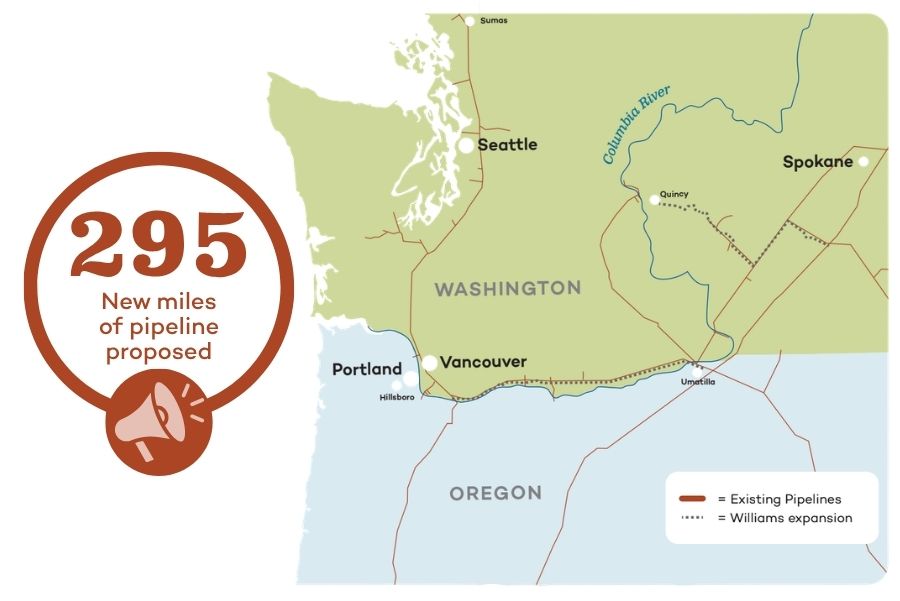
Rockies Columbia Connector
New Pipeline Through the Columbia River Gorge
The first of these two Williams proposals, the Rockies Columbia Connector, would bring a staggering quantity of new gas from the Rocky Mountains to Washington. Williams wants to add 158 miles of new pipeline along the Columbia River Gorge and expand air-polluting compressor stations along the route.
In 2025, Williams solicited buyer interest in the Rockies Columbia Connector from gas utilities and other entities. The stated capacity of this project in Washington is 123.3 billion cubic feet of gas per year.
This project should be a non-starter. Laying a new pipeline through the Columbia River Gorge would harm water quality and impact highly sensitive areas. The air quality implications for this project are enormous, especially considering communities along the I-5 corridor already experience significant concentrations of pollution.
Williams Companies, the owner of the largest gas pipeline system in Washington, has its eye on power-hungry data centers and is eagerly exploring options to build new gas pipelines.
Grant County
New Pipeline + Gas-Fired Power Plant
The second Williams proposal, the Valley Trail Project, calls for adding 137 miles of new pipeline in Grant County that would carry 123.3 billion cubic feet of gas per year. Data centers have flocked to this area, leading to concerns about water and energy consumption. In August 2025, the Grant County Public Utility District estimated that the 79 pending requests for utility service would consume approximately twice as much energy as the entire city of Seattle.
In January, the Grant County Public Utility District announced plans to explore the feasibility of constructing new gas-fired power plants near Moses Lake or Quincy. The materials reference a need for gas pipeline expansion in order to achieve supply.
New gas pipelines have no place in the Northwest. The short-term profits of greedy corporations are not worth sacrificing clean water, clean air, and healthy communities.
Stay up to date with our latest Currents newsletter