Ten years ago, the majority of our work was around the narrative, “The Thin Green Line,” as Columbia Riverkeeper and partners took on a plethora of companies trying to site the next coal, oil, methanol, and natural gas pipeline in river communities. We fought and won.
While we were doing that work, something quieter was being built and expanding. Today, we’re hearing about the “AI Data Center Boom,” and what that will mean for our river communities.
A good question to ask yourself is, “Why are we suddenly hearing about data centers, new nuclear construction (small modular nuclear reactors), gas pipeline expansion, pumped storage technology, and new power lines under the Columbia River?”
They might seem unrelated.
They’re not.
All these proposals on the Columbia River are connected to the massive electricity demand from the AI data center boom. Some quick facts about the issue:
- Unrestrained data center development in Washington and Oregon is unprecedented and threatens to derail state mandates to decommission methane and coal-fired power plants and reach 100 percent renewable energy.
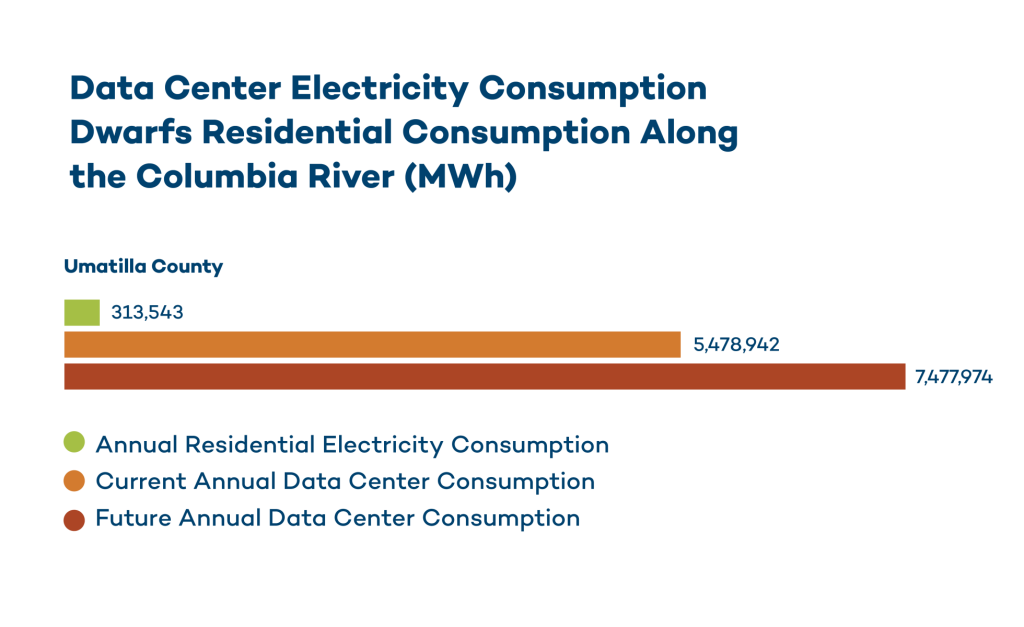
- Data center power demand in our region could reach 35 million MWh by 2029, the equivalent of adding as many as four cities the size of Seattle. Read more
- Columbia Riverkeeper’s “Closer Look Data Center Report” gives a deep dive about what’s happening in 12 counties along the Columbia River.
Why this matters
Data centers already consume huge amounts of power — and demand is rising fast with AI. According to Pew Research Institute, “Electricity consumption at U.S. data centers is expected to more than double by 2030.” That’s a massive shift for our energy system.
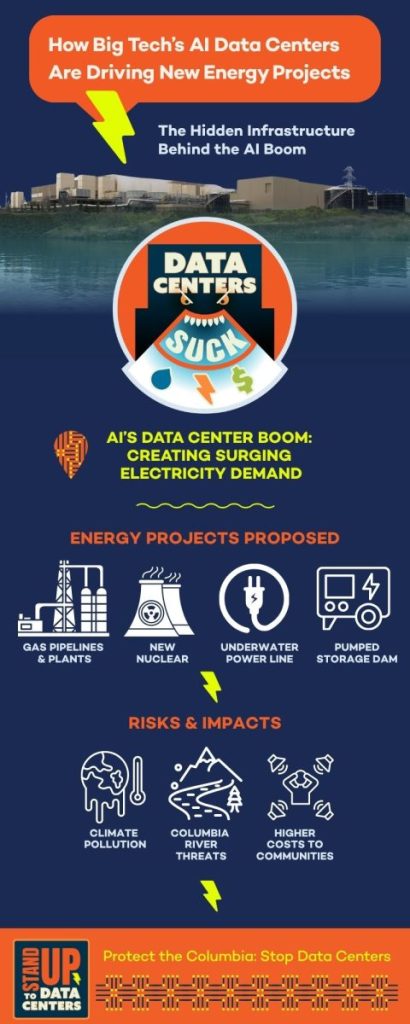
To power that demand, utilities across the U.S. are proposing new fossil fuel plants and pipeline expansions. The AI boom could mean more methane gas infrastructure, even in the Pacific Northwest.
Fossil fuel expansion
Earlier this year, Columbia Riverkeeper shared an astonishing discovery: Emboldened by the Trump Administration and the promise of data centers’ insatiable energy needs, the owner of the largest gas pipeline system in Washington is actively exploring options to build new gas pipelines in the Northwest. There are two early-stage gas pipeline proposals from Williams, owner of the Northwest Pipeline that carries methane gas from Western Canada and the Rocky Mountains through Washington and Oregon, and a proposal for a new gas-fired power plant by a Washington utility.
Nuclear enters the chat
Tech companies are also betting on small modular nuclear reactors (SMNRs) to power future data centers. But these reactors are experimental, expensive, and create dangerous waste. A new PBS program states: “The most TOXIC place in America is about to get WAY more dangerous.”
What’s the deal with a novel underwater powerline?
In the Northwest, new transmission projects are being proposed to move huge amounts of electricity to data center hubs. One proposal: a 100-mile high-voltage cable buried under the Columbia River.
There are serious concerns with the long- and short-term impacts of dredging a giant trench through the Columbia River. This is also a precedent-setting project. Placing a high-voltage, high-temperature line in the riverbed of an overburdened river system is too high-risk.
What about other “green” energy solutions?
The largest pumped storage development in the Pacific Northwest has been proposed in Goldendale, Washington to power new data center development. This development would destroy irreplaceable lands, medicines, and traditions of Pushpum, a sacred site to Yakama Nation and other Tribes.
This is environmental injustice, not clean energy. We have the opportunity to build a new and truly clean energy transition—one that breaks from past harmful extractive practices, one that does not exploit Indigenous communities, and one that does not come at the cost of sacred and irreplaceable resources. It’s not clean energy if it destroys Tribal cultural resources.
What can be done, the data centers are already built?
We need to prevent data centers from gobbling up limited clean energy. Columbia Riverkeeper is firmly opposed to small modular nuclear reactors as well as new fossil fuel projects introduced to provide energy to data centers. States should not compromise on energy efficiency or clean energy development to accommodate Big Tech’s appetite for more data centers.
Follow the money
States are offering major tax breaks to attract more data centers, accelerating the energy demand even further. In 2026, both Oregon and Washington legislatures eked small wins against data center tax incentives.
Data centers must pay their fair share. Given data centers’ impacts, Northwest states should end their practice of incentivizing development through tax incentives and make Big Tech pay its fair share. Tax incentives for data centers enrich the world’s wealthiest corporations while communities lose out on tax revenue for schools, public safety, and more.
Why do utilities want to build more energy infrastructure?
A report from the American Council for an Energy-Efficient Economy (ACEEE) shows that energy efficiency is still the cheapest and best response to rising energy demands, and could go a long way toward solving load growth driven by data centers.
It’s good to remember that “utilities often profit more from building than saving power.” Keep that in mind the next time you hear a public or private power company claiming it needs a new power plant. Grist digs into this more deeply.
Protect limited water resources
Data centers use enormous quantities of water, and the exact statistics regarding that water use should be made public. Any state approach to data center siting must include consideration of water availability, water quality impacts, impacts on the local water system, and how discharges into municipal water systems may affect that system’s capacity. In addition, water should not be allocated to data centers without first analyzing the impacts to watershed conditions, including stream flows for fish, temperature, pollution, and Tribes’ un-adjudicated federally reserved water rights.
“I think the question becomes, do we want to stick to our climate goals of getting to 100% renewable? Or do we want to have these big, mega data centers owned by big tech companies — some of the wealthiest corporations in the world — getting to use whatever energy they want? We would say, no, that’s not OK,” –Kelly Campbell, Policy Director, Columbia Riverkeeper.
In a 2025 report to the Washington Governor Data Center Workgroup, the Yakama Nation details how data centers impact strained river systems relied on by communities, fish, and wildlife, and shares actions lawmakers can take to protect water, air, and the climate.
When it comes to the AI data center boom, put it all together and you see the pattern:
- More electricity demand
- Methane gas pipelines
- Nuclear proposals
- Pumped storage proposal
- Massive transmission projects
The questions we should be asking: Who benefits — and who bears the risks to our climate, rivers, and communities? Learn more.
Data Centers in the News:
- Wired: Data Centers Are Driving a U.S. Gas Boom
- PBS: The Most Toxic Place in America Is About to Get Way More Dangerous
- OPB: Data Centers Could Worsen Air Quality in Eastern Oregon’s Umatilla Basin
- NWPB: Part of an Old Aluminum Smelter Along the Columbia River Could Soon Get Cleaned Up. An Energy Project Is Helping Fast-Track the Work
- NW Council: Northwest Power and Conservation Council Fish and Wildlife Program
- KLCC: At What Cost? Data Centers in Oregon Often Cost More Than They Earn
- KGW: Oregon Lawmakers Pass One-Year Tax Break Moratorium for Data Centers
- CounterPunch: Vampire Planet: Data Centers Are Worse Than You Think
- Oregon Capital Chronicle: Going Green Now for Who? Yakama Protest Clean Energy Project on Sacred Site to Power Data Center
- Grist: The U.S. Doesn’t Need to Generate as Much New Electricity as You Think
- Columbia Insight: How Data Centers Pose a Unique Threat to Pacific Northwest Tribes
- Yakama Nation: Report on Data Centers
- KOIN News: Washington group calls for data center moratorium. Here’s what to know
Columbia Riverkeeper Resources
- (Campaign) No Underwater Power Line
- (Campaign Stand Up to Data Centers
- (Blog) 2026 Legislative Session Wrap-Up
- (Report) A Closer Look: Data Centers on the River
- (Report) Dirty Secrets: Data Centers Drive Demand for Gas in Oregon, Washington
- (Campaign) Protect Pushpum